


TL;DR: Looking for a feature such as a color can make a matching object easier to notice, but that advantage depends heavily on where the object appears. Across four inattentional-blindness experiments, the benefit was strong inside the attended region and substantially smaller or absent outside it.
What We Look For Is Only Part of What We See
Imagine scanning a crowd for a friend in a red shirt. Holding “red” in mind creates an attention set: a temporary priority for a feature that helps matching objects compete for awareness. Many accounts treat that priority as field-wide, as though setting attention for red boosts red objects wherever they appear.
Location introduces a second filter. People direct spatial attention toward the region where a task is unfolding, and they can miss a visible but unexpected event elsewhere. That failure is called inattentional blindness. The question behind this study was whether a feature match can overcome that spatial boundary. If an unexpected object has exactly the color a person is tracking, will it capture awareness even in a region that person has no reason to monitor?
The experiments show that the answer depends on both what the object is and where it appears.
Testing Features Against Location
Participants watched black and white Ls and Ts move around a gray display. They counted events involving one color, creating an attention set for that color. On a critical trial, a cross appeared without warning and traveled either through the task area or beyond it. Afterward, participants reported whether they had noticed anything new and answered questions about its appearance. A participant counted as noticing the cross only after reporting it and correctly identifying at least one of its features.
The four web-based experiments tested 2,272 U.S. adults recruited through Amazon Mechanical Turk; 1,568 remained after preplanned exclusions. Experiment 1 was exploratory, and Experiments 2 through 4 were preregistered. Across studies, the cross could match the tracked color, match the ignored color, or be a salient red that differed from every other moving object. Later experiments also changed the display to test whether clutter or distance from fixation could explain the pattern.
This design joined two established influences on noticing in a single task: similarity to the observer’s attention set and proximity to the current focus of spatial attention.
The Same Set Had a Smaller Reach
Experiment 1 provided an initial surprise. When the cross appeared outside the task area, 70% of participants noticed a salient red cross, compared with 38% who noticed a white cross matching their attention set. Away from the attended region, standing out from the display mattered more than sharing the tracked color.
Experiment 2 supplied the clearest feature-by-location comparison. Inside the task area, 89% noticed a white cross that matched the attended color, while only 6% noticed a black cross matching the ignored color. Outside the task area, noticing was lower for the matching white cross and higher for the nonmatching black one: 50% versus 27%. The attention-set advantage therefore fell from 83 percentage points inside to 23 points outside, a statistically significant interaction.
This was not just a general decline in visibility away from the task. The matching cross became less likely to be noticed outside the attended region, but the nonmatching cross became more likely to be noticed there. The location of attention changed how strongly the feature set shaped awareness.
Clutter and Gaze Narrowed the Explanation
Experiment 3 placed moving letters in both the attended and unattended regions so that differences in visual clutter would not carry the result. Inside the task area, noticing was 87% for a matching cross and 7% for a nonmatching one. Outside it, the rates were 5% and 4%. Equal clutter again produced a statistically significant interaction, although the very low outside rates leave open the possibility that a floor effect concealed a small feature-matching benefit.
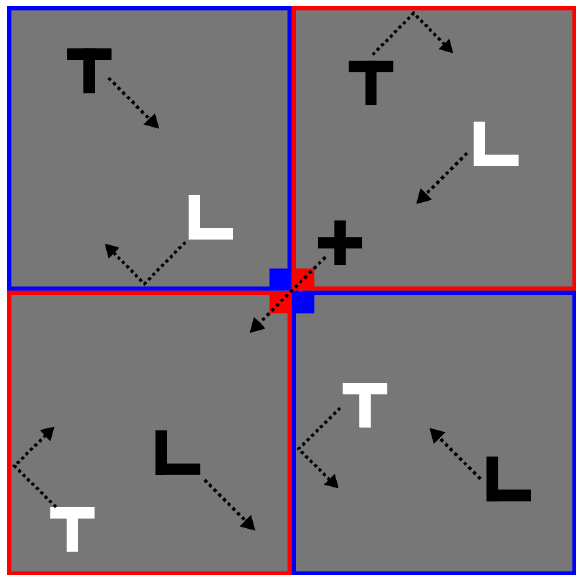
Experiment 4 addressed another alternative: the unattended region had previously been farther from the center of gaze. Participants instead attended two diagonally opposite quadrants while the cross crossed attended or unattended quadrants at comparable distances from fixation. The attention-set advantage remained larger inside than outside: 77% versus 28% in attended quadrants, compared with 31% versus 11% in unattended ones.
That final interaction did not reach the conventional threshold for statistical significance (p = .072). The direction matched the earlier experiments, but the smaller difference suggests that gaze proximity may explain part of the spatial effect.
Why “What” Cannot Be Separated From “Where”
Together, the experiments challenge the idea that a feature-based attention set operates uniformly across the visual field. A matching feature can strongly shape what reaches awareness where attention is already directed, yet provide much less help elsewhere. The study does not establish whether this pattern reflects enhancement of attended features and regions, suppression of unattended regions, or both.
The distinction matters for attempts to make hazards resemble what observers expect. Making a motorcycle look more like a car, for example, might help when it appears within a driver’s attended region. If it enters from an unattended side road, matching expectations may offer less benefit; reducing its visual distinctiveness could even make it harder to notice. We therefore argue for more research before turning feature matching into safety policy.
Those implications remain bounded. The studies used simple computerized displays and demanding tracking tasks with adults who passed vision and color-vision checks. They did not test driving or other real-world behavior directly. The strongest conclusion is narrower: what people are prepared to see works together with where they are already attending.
Full Citation
Stothart, C., Simons, D. J., Boot, W. R., & Wright, T. J. (2019). What to where: The right attention set for the wrong location. Perception, 48(7), 602-615. https://doi.org/10.1177/0301006619854302