


TL;DR: Finding one target can change what a searcher expects to find next, making a second target easier to miss. In a 96-person laboratory study, a stronger bias toward expecting only one target was associated with shorter continued searches and more subsequent-search misses, even after accounting for time spent searching after the first find.
When One Find Makes the Search Feel Finished
Finding something does not always mean a search is going well. When a display contains multiple targets, people are more likely to miss one after they have already found another. These subsequent-search misses appear in laboratory tasks and were first studied in radiology, where one image can contain more than one abnormality.
For decades, these errors were called “satisfaction of search.” The name suggested that finding one target makes a searcher feel finished and stop too soon. Yet studies of radiologists often found that they did not simply abandon an image before scanning it. Other explanations gained ground: a first target may tune attention toward similar-looking objects, or finding and remembering it may consume resources needed to locate the next.
This study revisited satisfaction from a different angle. “Satisfied” need not mean pleased or careless. It can mean reaching an expectation that further effort is unlikely to pay off.
Expectations Built From the Search Itself
Suppose a display contains two targets. On average, one of them should be found sooner than the single target in a one-target display because either one can become the first find. Searchers may learn this relationship implicitly. If the first target appears quickly, another may seem plausible; if it takes a long time, the display may feel more likely to contain only one.
That judgment creates a possible feedback loop. A long search for the first target lowers the expected chance of a second. The lower expectation makes continued searching seem less worthwhile. Ending sooner then leaves less opportunity to discover a target that was present all along.
The key question was therefore not only whether people searched long enough. It was whether each person’s expectations, inferred from their own search behavior, were associated with the errors they made.
Interrupting the Task to Capture a Belief
Ninety-six University of Notre Dame undergraduates searched displays containing 20 objects. The targets were perfect Ts hidden among misaligned Ts. Every trial contained either one or two targets, and participants were accurately told that each trial type occurred half of the time.
Across 252 experimental trials, two kinds of trial were randomly mixed:
- On one third of trials, the display disappeared as soon as the participant clicked the first target. The participant then guessed whether an unfound second target had been present and separately reported whether they had already seen it.
- On the remaining trials, participants could keep searching until they clicked “Done” or reached a 15-second limit. These trials measured how often a target was found after another target had already been located.
The interrupted trials captured expectations without giving participants a chance to verify them. The separate “did you already see it?” question allowed the analysis to exclude trials on which a guess was really based on a glimpse of the second target. The uninterrupted trials then supplied an independent measure of each person’s susceptibility to subsequent-search misses.
Expectations Fell Faster Than Reality
The longer participants took to find the first target, the less likely a second target actually was. Their guesses followed the same direction, but declined much more steeply. In other words, elapsed search time contained useful information, yet participants put too much weight on it. As the first-target search grew longer, they increasingly underestimated the chance that another target remained.
The performance cost was substantial. Participants found a target on 98.46% of one-target trials, when they had not already found anything. On two-target trials, after one target had been found, the probability of finding the other averaged 69.13% - a 29.33 percentage-point subsequent-search-miss effect.
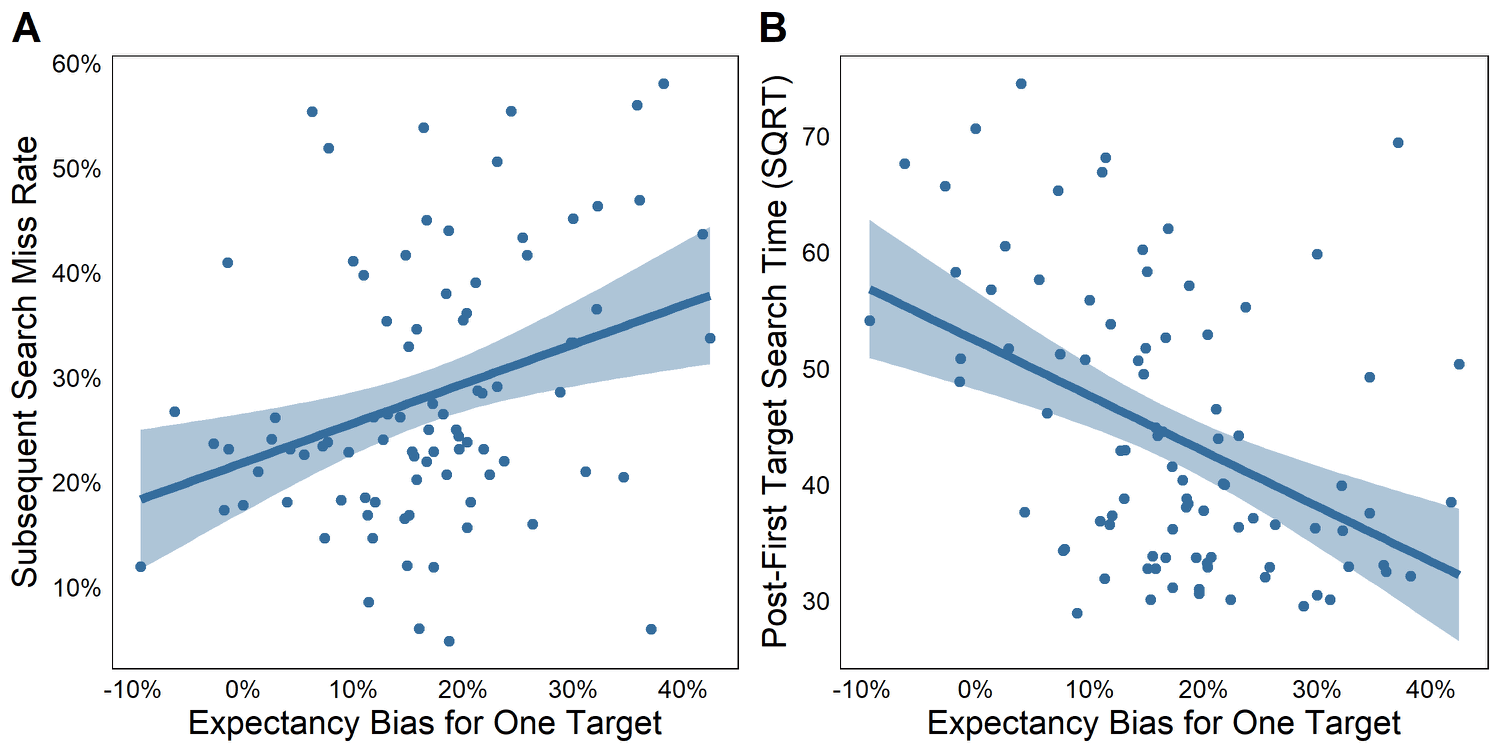
Individual differences connected expectation to error. People with a stronger one-target expectancy bias had higher miss rates (p = .002) and stopped searching sooner after the first find (p < .001). Expectancy bias also predicted misses beyond post-first-target search duration: adding it to the model increased explained variance from 9% to 13% (p = .032). The belief measure and the time measure were related, but they were not redundant.
What “Satisfaction” Explains - and What It Does Not
The findings offer a mechanism for the old satisfaction account: searchers appear to form within-trial expectations from their own progress, and those expectations are associated with when they stop. This mechanism can coexist with perceptual-set and resource-depletion explanations. A first target may change what receives attention, consume memory resources, and alter the searcher’s estimate that another target is worth pursuing.
The study does not show that expectation alone caused the misses. Its central evidence comes from individual differences, and the participants were undergraduates completing a simplified task with known, evenly balanced target frequencies. Professional searches can involve expertise, rare targets, several target types, unequal consequences, and uncertainty about how many targets are possible.
Those limits make training a research question rather than a demonstrated solution. It may be possible to teach searchers to notice when elapsed time is pushing their expectations below reality, or to require a deliberate second pass after a first find. Whether either approach reduces errors in radiology, security screening, or other professional settings remains to be tested. The bounded conclusion is clearer: what people expect to remain can help explain why finding one target makes the next easier to miss.
Full Citation
Stothart, C., & Brockmole, J. R. (2019). “Satisfaction” in search: Individuals’ own search expectations predict their errors in multiple-target search. Attention, Perception, & Psychophysics, 81, 2659-2665. https://doi.org/10.3758/s13414-019-01790-9