


TL;DR: We designed and tested the first scenario-based training program for "thinking in time," a complex cognitive skill. U.S. Army officers rated it highly; junior officers reported greater confidence afterward, while senior officers reported a small decline that may reflect a clearer sense of the skill's complexity.
Why the skill needed a training program
Timing matters in leadership. Leaders need to connect the past, present, and future to make sound decisions, a skill the historians Richard Neustadt and Ernest May called "thinking in time." It is central to strategic thinking and helps leaders avoid misreading the present because it resembles the past.
Yet the skill is rarely taught formally. Although the U.S. Army depends on strategic planning, it had no "deliberate and scalable development program" for thinking in time. Leaders were expected to acquire it through experience. We wanted to turn this abstract idea into a skill that could be taught and practiced.
Defining thinking in time
Before we could design training, we needed to define the skill. We reviewed the literature on strategic thinking, applied history, and cognitive biases and conducted in-depth interviews with 25 subject matter experts (SMEs), including Army senior leaders, historians, strategists, and futurists. This analysis led to a consensus definition:
Thinking in Time: A cognitive reasoning skill by which the dimension of time (past, present, and future) is used to support the decision-making process.
We identified seven facets that could be taught and practiced:
- Historical Perspective-Taking means understanding past actions from the perspective of those who lived them.
- Experiential Reflection uses relevant personal experiences to fill information gaps.
- Historical Reasoning compares current problems with past analogies to identify similarities and differences.
- Framing Causal Chains identifies and hypothesizes causal sequences of decisions, actions, reactions, counteractions, and outcomes.
- Trend Analysis identifies underlying patterns and uses them to predict future outcomes.
- Foreknowledge incorporates known, "safe-to-assume" future events, such as budgets or troop movements, into planning.
- Forecasting considers several likely futures, compares their likelihood, and uses them to plan for a desired end state.
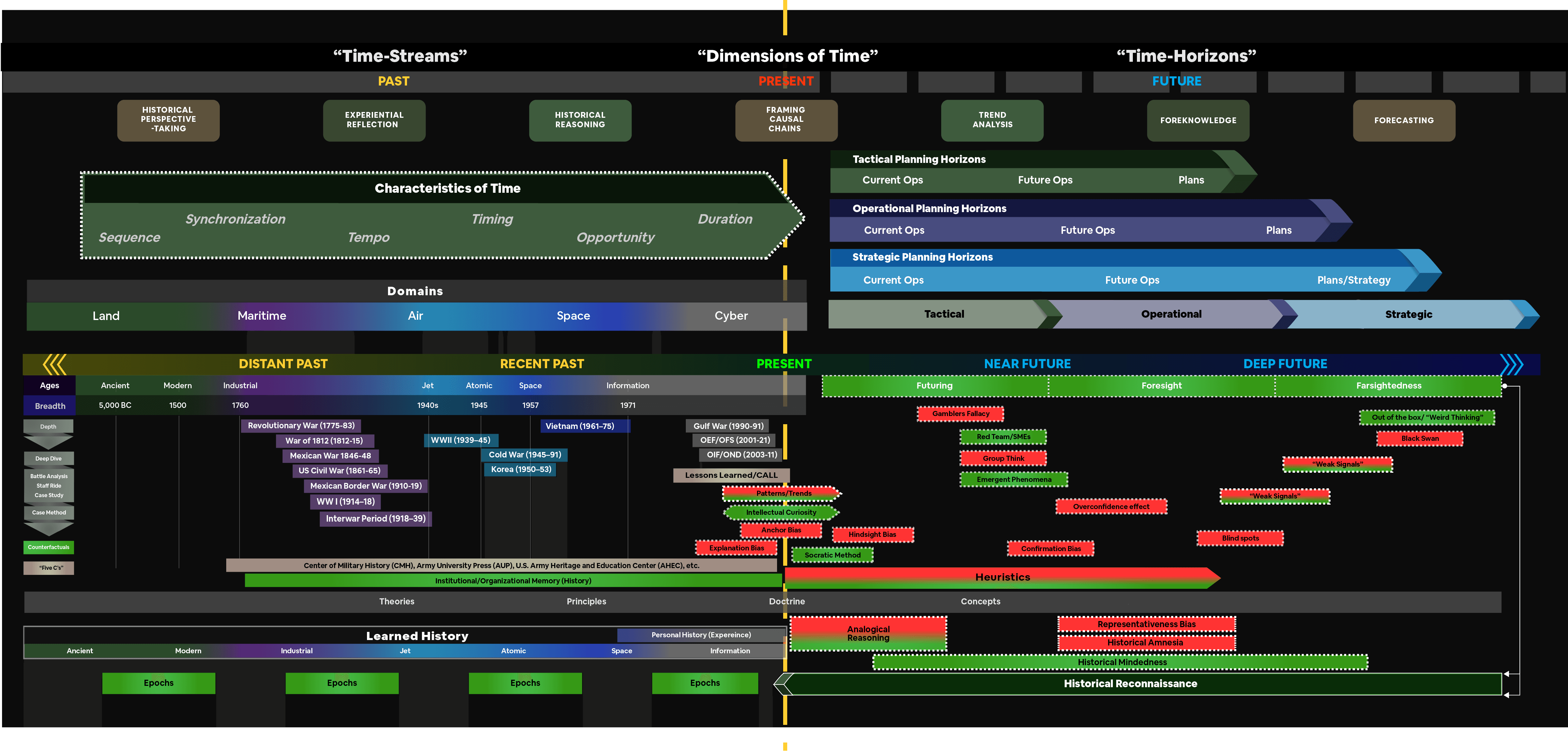
Our conceptual model of time, shown above, organizes these facets alongside cognitive biases and planning horizons. The model provides the framework for the training.
Four modules built around realistic scenarios
We used the Analysis, Design, Development, Implementation, and Evaluation (ADDIE) model to design, develop, and test a four-module interactive multimedia instruction (IMI) tool for mid-career officers. We designed the course for practical use, with realistic scenarios for applying the concepts.
Module 1 introduces the definition and conceptual framework. Module 2 focuses on the past through the 20-year U.S. involvement in Afghanistan. Officers use historical reasoning and identify causal chains to understand that complex history.
Module 3 focuses on the present through a notional crisis involving China, Mexican cartels, and border security. It uses a five-step thinking-in-time process to frame a current, ambiguous problem:
- Develop Historical Estimate (Understand)
- Visualize End State and Conduct Historical Reconnaissance
- Describe Historically Sound Actions/Approaches
- Conduct Historical and Heuristic Wargaming and Retrospective Test
- Decide, Direct, and Assess
Module 4 turns to the Army's recruiting shortfall and its impact on the future force. Officers apply all seven facets to this institutional challenge to anticipate and shape future outcomes.
What officers reported
We tested the four-module program with 80 Army officers, from lieutenants to a brigadier general. Most participants responded positively and reported gaining practical tools and a better understanding of the skill:
- 73% agreed they "gained more tools and skills for deliberate planning".
- 76% agreed the program "enhanced their understanding of the dimension of time" in decision-making.
- 91% found the conceptual framework a "useful tool for comprehending and visualizing" the skill after completing Module 1.
- 75% agreed the scenarios were effective at illustrating the concepts.
Participants rated their understanding of thinking in time before and after training. Among junior officers (company grade), the percentage who felt confident in their ability rose by 31 percentage points. Among senior officers (field and general grade), it fell slightly, from 69% to 64%.
This difference suggests the training may help officers in different ways. For junior officers, it offers new cognitive tools and a concrete mental model. For senior officers, working through the skill's complexity and cognitive biases may have tempered earlier overconfidence and encouraged a more realistic assessment of their ability.
Using the training
The program is ready to use. We recommend introducing it early in a leader's career and reinforcing it periodically to develop leaders who can use the past to make better decisions under uncertainty.
Full Citation
Stothart, C., Young, R. G., Burbelo, G. A., Cobb, M. G., Normand, S. L., DeLoia, M. A., Ejiogu, K. C., & Woody, B. (2024). Thinking in time: A scenario-based developmental method for Army officers (ARI-SS SR 2024-31). U.S. Army Research Institute for the Behavioral and Social Sciences.