


TL;DR: Phone notifications can disrupt attention even when you leave the phone alone. We found that receiving phone notifications impaired performance on a demanding attention task, with effects comparable to those reported for actively texting or talking on a phone.
Distraction before you pick up the phone
Texting while driving is dangerous because phone use divides attention and can lead to mistakes. The usual advice is "Just wait to respond. Put the phone down and focus."
Our study found that distraction can begin when the notification arrives, before you pick up the phone. Policies and personal habits that focus on when to respond can overlook the attention cost of the notification itself.
Why an interruption can linger
We hypothesized that the brief sound or vibration of a notification could prompt "task-irrelevant thoughts," or mind wandering, that outlast the alert. You might wonder who contacted you, whether it's urgent, and then remind yourself to check later.
Remembering to check later may create a prospective memory demand, a cognitive burden that takes attention from the task. You may continue performing the task while your thoughts are elsewhere.
How we tested attention
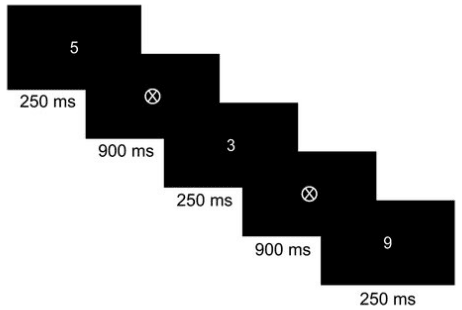
Participants completed the Sustained Attention to Response Task (SART), a simple task designed to measure sustained attention. They watched numbers flash on a screen and pressed a key for every number except 3.
The task is easy to understand, but doing it accurately over time requires sustained focus. Pressing the key when a 3 appears is a "commission error," a sign of a lapse in attention.
After a brief practice round, participants completed two main blocks of 360 trials each, separated by a one-minute break. We sent no study notifications during the first block, which gave us a baseline measure of each participant's performance.
We randomly assigned participants to a call group, a text group, or a control group. In the second block, we sent four calls to each participant in the call group and four messages to each participant in the text group, spaced 90 trials apart. We sent no notifications to the control group in either block.
Participants used their own phones. We collected their numbers, along with demographic information, on a standard electronic check-in sheet when they arrived. They did not know that this was related to the experiment or that the study concerned cell phones. This made it plausible that participants would regard the calls and texts as personally relevant communications.
The experiment program used the Twilio application programming interface to send calls and texts automatically at precise points during the task. It also assigned participants to groups, so the experimenter in the room did not know each participant's condition.
We excluded data from anyone who looked at or handled their phone. This let us examine the attention cost of receiving a notification without interacting with the phone.
What we found
Commission errors became more likely in the second block, as often happens during a long attention task. Both notification groups showed a significantly greater increase from the first block than the control group did. The control group's change helped us assess how much notifications added to the decline in performance over time.
The text finding needs some caution: that group started with fewer errors than the control group, and their error rates were similar in the second block. Its larger increase could partly reflect the lower starting error rate, so the evidence for distraction from texts is less conclusive.
The call group also showed a greater increase between blocks than the control group in "anticipations": responses so fast that participants likely made them before recognizing the number. The text group's increase did not differ significantly from the control group's. These fast responses suggest that participants were responding automatically rather than attending to each number.
The distraction we observed was comparable in size to the performance costs reported in studies of texting and driving.
Implications for daily life
Work and learning
Writing a report, coding, and studying for an exam all require sustained attention. Our findings suggest that even a phone set to "silent" can disrupt concentration if it vibrates on the desk. Ignoring the phone may still leave some attention off the task, making learning less efficient or reducing the quality of work.
Conversations and decisions
In an important meeting or a difficult conversation, attention to nuance matters. A complex decision may demand the same focus. An ignored notification may divert some of that attention to "Who was that?" or "What do they need?"
Everyday tasks
Driving, cooking a complicated meal, and watching children all require sustained attention to monitor events and respond. Our findings suggest that notifications may distract from such tasks and create opportunities for errors, such as a missed stop sign, a burned dinner, or an unnoticed danger.
Putting the phone down may not be enough if it can still sound or vibrate. The interruption itself can take attention away from what you're doing.
Full citation
Stothart, C., Mitchum, A., & Yehnert, C. (2015). The attentional cost of receiving a cell phone notification. Journal of Experimental Psychology: Human Perception and Performance, 41(4), 893–897. https://doi.org/10.1037/xhp0000100